7/13
I’ve been reading Born to Run by Christopher McDougall. It’s been described by some as the barefoot runner’s manifesto. Basically it’s the story of McDougall’s personal running journey, injury issues and curiosity which eventually leads him to seek and spend time learning from a largely unknown native tribe in Mexico called the Tarahumara (or Rarámuri, the Running People). They are known as some of the best runners on planet earth. They run ultra-marathons well into old age. And the fact that I can’t get out of my brain is that they run in what basically amount to homemade sandals. The Tarahumara aren’t buying $180 Brooks Glycerins online, I doubt any company would be willing to ship to the Copper Canyons even if they did. They rarely get injured, and they don’t face the chronic issues modern runners deal with: plantar fasciitis, shin splints, etc.
I bought the Brooks Ghost Max’s last week and when I unboxed them, they reminded me of my first pair of Hoka Clifton 9s. The stack height was tall, to be expected. The cushioning was pillow-like. The shoe itself, shockingly light for the size. But I couldn’t get this thought out of my head: “all this brainpower and energy and engineering and yet, based on historical data, some 65% of runners will sustain some sort of injury this year.”
What are we doing wrong? I’m the wrong guy to answer this question, because a lot of people are doing a lot of things right. For those who find themselves at this fork in the road where I am, there are probably multiple answers depending on the person. But I ask it because reading this book got me interested in the idea of running barefoot. I figure, “if our distant ancestors did it-hell, if I did it as a small child, why should I assume I can’t right now?” On Saturday I tried run-walking one mile on grass. I felt so good after the first mile I ended up running three and a half. It felt great. I ran the grass segments and walked when pavement was the only option. My feet are pretty beat up but I thoroughly enjoyed the feeling. There were moments I felt like a kid again. I wasn’t worried about pace, mechanics, heart rate zones, etc. I was enjoying the ebbs and flows, the change in stride length to avoid sticks, the way my hips shifted as I alternated between pavement and grass. It was the definition of joy. The sun was warm against my back. The road and grass segments I chose were uneven and sloped. I didn’t care. My average pace for the entire run was 12:44/mi but there were moments I felt I was flying. It was like I was falling in love with running all over again.
7/15
On Sunday we took the kids out for a walk. It was cut short due to a great conversation with our neighbor Nick who, we found out, owned several iconic Springfield restaurants over the years (including Ebbett’s Field from 1972-2002). We walked 1.2 miles together and I did it barefoot. Around the 0.9 mile mark a large pebble dug into the back of my right heel. I howled like a wounded dog. It hurt like crazy. No blood, but my heel has been sore ever since. After some rest time and ice, I ran 8 miles that afternoon in my Ghost Max shoes (my third run in them overall). My goal was to focus on my cadence and my landing, specifically toe striking. Any time I’ve tried to focus on running mechanics for a long run in the past, my focus starts to diminish after mile 4. To combat this, I tried listening to a playlist of only nine songs all from the same album (State Champs, self-titled album from last year if you’re curious). Cody Ko said in his training that listening to the same song on repeat helps in get into the “flow” state. I wasn’t sure if I could handle that much repetition.
Here are my cadence charts from my last two runs of similar length.
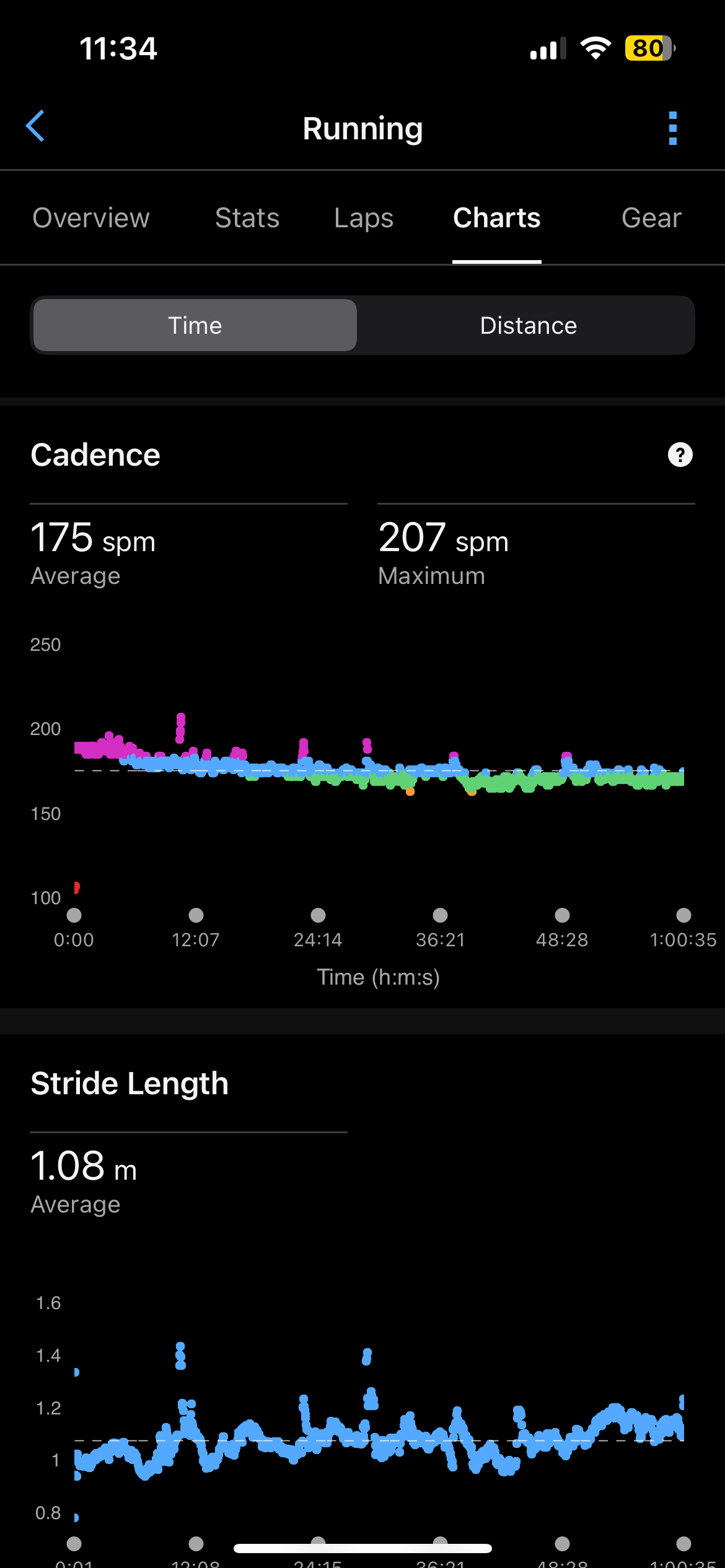
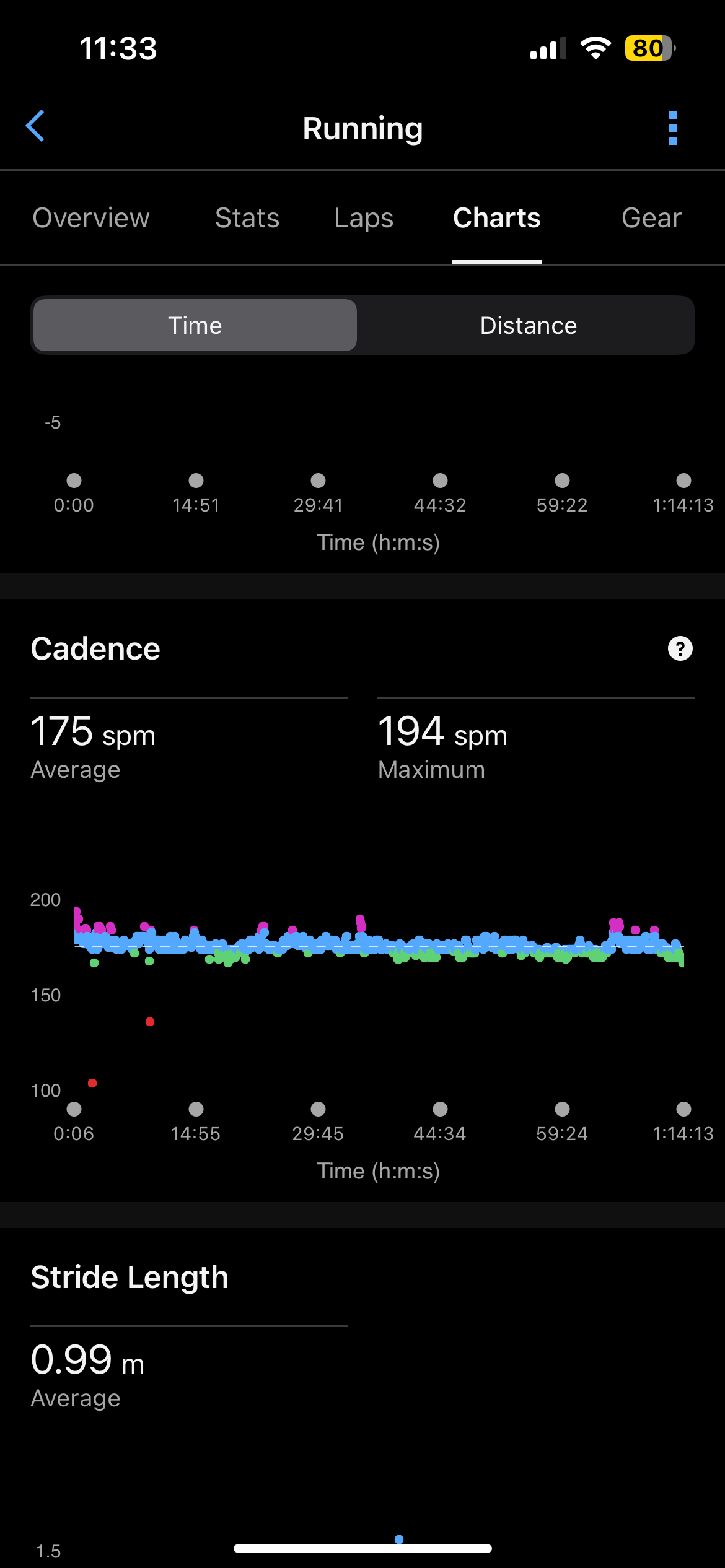
I attached these two cadence charts to show what I noticed on Sunday. Turns out, I was able to focus on my mechanics quite well on this run. When compared to Friday’s run, you can see I was much more consistent throughout the run. Based on the chart, the difference in cadence between the first few minutes of mile 1 and the final moments of mile 8 was minimal. Compare that to the Friday run and the difference is definitely noticeable. For starters, because I was heel-striking, I was able to start at a much higher cadence in the beginning of the run because I wasn’t doing anything outside of my comfort zone. And the drop off in cadence illustrates the deeper point here: if I don’t focus on running economy or my mechanics consistently throughout a run, I can keep a good cadence for a time but once fatigue sets in, I revert to bad habits quickly and I lengthen my stride to make up for the lower cadence. The more I focused on good mechanics and running economy, the shorter my stride and therefore, a higher, more consistent cadence.
Are you sick of reading the word “cadence” yet?
So what does all that mean? I have only been running for a couple years now so I’m not an expert but one thing that I’m hoping it means is that I’m improving my chances to stay healthy and prevent injury. Each step I take is a tremendous amount of force on my body (I’ve read from smart people in the running world that your lower body sustains 2-3 times your bodyweight of force when you run). Higher cadence means less stress on my soft tissue and my joints. Being less “bouncy” (vertical oscillation) with each stride will help keep me in good running shape as I age. That’s the goal with all this. I don’t want to enjoy running just long enough for my body to fail me. An older friend of mine quoted his physical therapist a few weeks back, “running is the best thing you can do for your cardiovascular health, and the worst thing you can do for your soft tissue and joints.” I don’t know if he’s right. But I’d like to prove him wrong by running well into my 70s.
The question I’m asking myself is, “so what’s the plan now?” I don’t know the answer yet. I know a couple things for a fact: I loved barefoot running and I think I can incorporate it into my weeks to allow myself more “fun” training since I’m now fast approaching the dog days of my marathon block. I also know that I’m too close to my race to realistically become a full time barefoot runner or run the race in minimalist shoes. Maybe that’s where my training will lead me some day, but for now I’m going to have to stick with what’s got me here. If running shoes have led to increased injuries in the last 50 years, I’m sure that reversing course and attempting to run a full marathon barefoot with only 5 months to go can cause injuries at an even higher rate.
Here’s the third thing I know.
I want to run for the rest of my life. I don’t know if there’s running in heaven but if there is, I want to run there too. That feeling I had running barefoot on Saturday, I’m going to chase that feeling for a long time. I thank God for healthy legs when I’m out for a run. I probably don’t thank Him enough but writing this blog has really helped me meditate on how lucky I am, how lucky we are, to learn what it means to endure. The sweat is worth it.
Keep Going!

 David Taylor Gonzales
Leave a reply to Lane Cancel reply